
Can I Use Human Shampoo on My Dog?
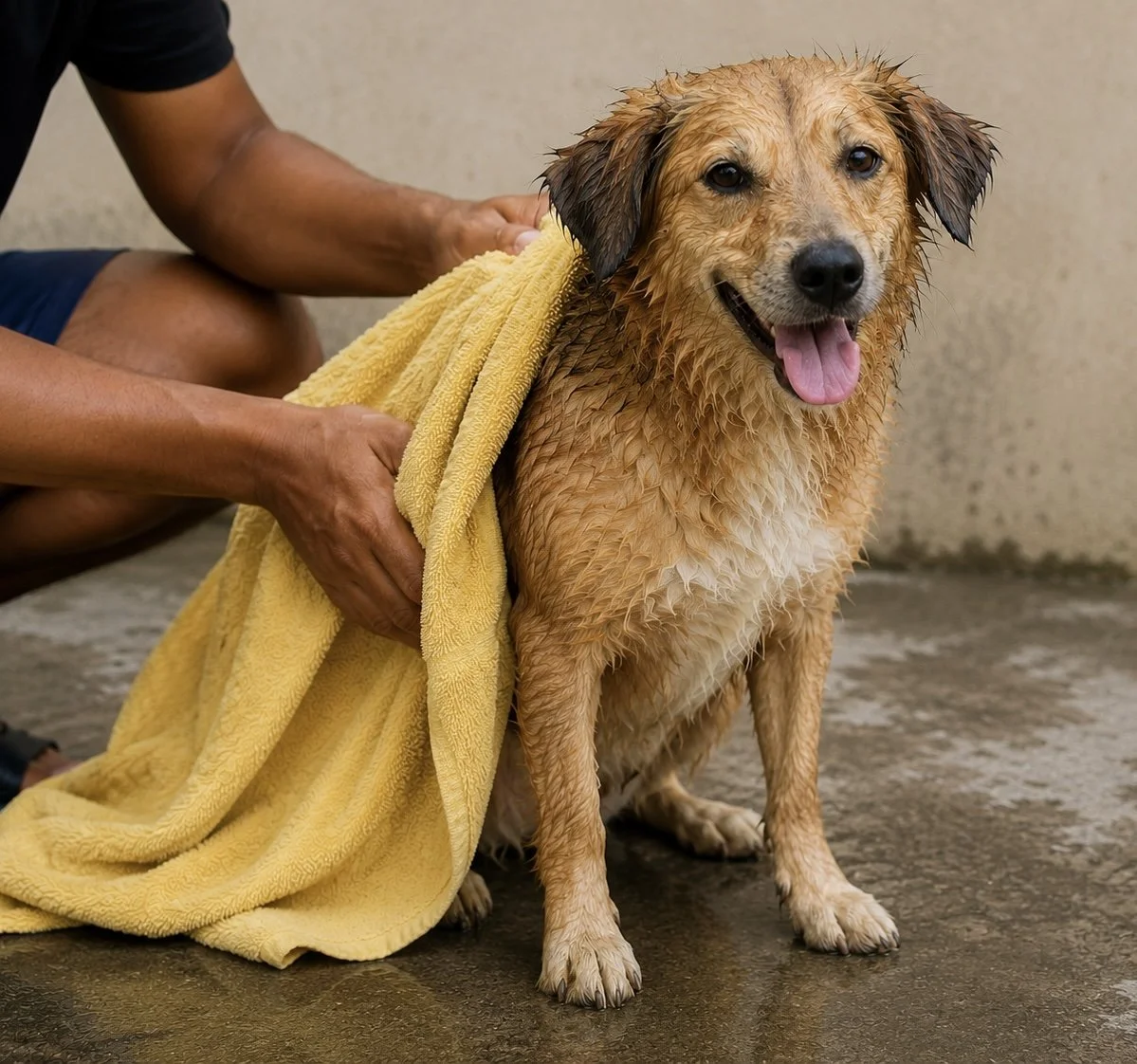
Choosing the right shampoo for your dog matters more than many owners realise.
Whether your dog has healthy skin or is being treated for a dermatological condition, choosing products specifically formulated for dogs helps protect the body’s natural barrier against the outside world.
Dogs Are Not Small Humans
One common misconception is that because a human shampoo is labelled as “hypoallergenic”, “gentle” or “for sensitive skin”, it must also be safe for dogs.
This isn’t exactly true.
Dogs have a thin and unique outer skin layer, and their skin pH is much closer to neutral than that of humans. Human skin is naturally acidic, and human shampoos are specifically formulated to work within that acidic environment.
This difference is more important than many people realise.
A shampoo that is perfectly suitable for human skin may disrupt the normal environment of canine skin, strip away protective lipids, increase water loss and weaken their skin’s natural barrier against infections, parasites and environmental allergens. Over time, this can increase the risk of irritation, inflammation and secondary skin infections.
But It’s Baby Shampoo…
“If it’s gentle enough for a baby, it’s gentle enough for a dog”
It sounds logical. However, baby shampoos are formulated to be gentle on human babies, not on dogs.
Although they are generally milder than many adult shampoos, they are still designed for human skin physiology and the naturally acidic pH of human skin. They should not be considered a substitute for shampoos specifically formulated for dogs.
The question should not be:
“Is this shampoo gentle?”
The better question is:
“Was this shampoo designed for canine skin?”
What About Head and Shoulders?
Perhaps the most commonly used human shampoo on dogs is anti-dandruff shampoo. The reasoning is understandable. Owners notice flakes on the coat and naturally assume their dog has dandruff, just as people do.
Unfortunately, the situation is usually very different.
In people, dandruff (seborrhoeic dermatitis) is a scalp disorder commonly associated with increased skin cell turnover and the yeast Malassezia.
In dogs, however, scaling is a clinical sign, not a diagnosis.
Primary seborrhoea is relatively uncommon and tends to occur in certain breeds like the cocker spaniel. In most dogs, visible flakes are caused by an underlying skin disease rather than a primary dandruff disorder.
Treating the flakes without identifying the underlying cause often provides little benefit.
In addition, human anti-dandruff shampoos are formulated to treat human scalp disorders, not the wide range of diseases that cause scaling in dogs. Some also contain zinc pyrithione, an ingredient that can be toxic if ingested by dogs during normal self-grooming. Modern veterinary dermatology has largely moved away from this ingredient in favour of safer alternatives specifically developed for canine skin.
Is Frequent Bathing Bad for Dogs?
Another common misconception is that bathing too often damages a dog’s skin.
In reality, bathing itself is rarely the problem.
Using the wrong shampoo is.
Modern veterinary shampoos are specifically formulated for canine skin and, depending on the product selected, may help maintain skin hydration, support the skin barrier, remove dirt and environmental allergens, and reduce bacteria and yeast on the skin.
For many healthy dogs, routine bathing with an appropriate veterinary shampoo can be an important part of maintaining healthy skin and coat quality.
In dermatology patients, bathing is often an important part of treatment rather than something to avoid. Many veterinary shampoos are specifically formulated and licensed for frequent or even daily use.
When a shampoo is designed for canine skin and the manufacturer’s label indicates it is safe for frequent use, dogs can be bathed as often as necessary to help manage their condition or remove allergens and debris from the coat.
So then, which shampoo is the best?
The answer depends entirely on the individual dog.
A healthy puppy, an allergic Labrador, a dog with a bacterial skin infection or a patient with seborrhoea may all require completely different products.
The most appropriate shampoo depends on the health of the skin, the underlying diagnosis where appropriate and the recommendation of your veterinary dermatologist, not simply because it is marketed as “medicated”, “natural” or “gentle.”
The Bottom Line
Human shampoos, dandruff shampoos or baby shampoos should not be used as substitutes for veterinary shampoos.
Although some contain familiar active ingredients, important differences in skin pH, formulation and skin biology mean they may be ineffective, irritating or even harmful when used on dogs.
Whether your dog has healthy skin or is being treated for a dermatological condition, choosing products specifically formulated for canine skin is one of the simplest ways to protect the skin barrier and maintain healthy skin throughout life.
If your dog develops persistent itching, hair loss, recurrent ear infections, scaling, redness or an unpleasant skin odour, the answer is rarely a stronger shampoo. The most important step is identifying the underlying cause so the most appropriate treatment can be selected.
DermaVet TT
June 2026
References:
Bajwa, J. (2025) ‘Shampoo therapy in veterinary dermatology: Benefits and practical tips’, The Canadian Veterinary Journal, 66(12), p. 1354.
Banović, F. and Lemo, N. (2019) ‘Topical therapy in veterinary dermatology’, Veterinarska Stanica, 50(3), pp. 239–246.
Bizikova, P., Santoro, D., Marsella, R., Pucheu-Haston, C.M. and Eisenschenk, M.N.C. (2015) ‘Review: Clinical and histological manifestations of canine atopic dermatitis’, Veterinary Dermatology, 26(2), pp. 79–e24.
Gwaltney-Brant, S.M. (2013) ‘Zinc’, in Peterson, M.E. and Talcott, P.A. (eds.) Small Animal Toxicology. 3rd edn. St. Louis: Elsevier, pp. 807–811.
Hillier, A., Lloyd, D.H., Weese, J.S., Blondeau, J.M., Boothe, D., Breitschwerdt, E., Guardabassi, L., Papich, M.G., Rankin, S., Turnidge, J.D. and Sykes, J.E. (2014) ‘Guidelines for the diagnosis and antimicrobial therapy of canine superficial bacterial folliculitis (antimicrobial guidelines working group of the International Society for Companion Animal Infectious Diseases)’, Veterinary Dermatology, 25(3), pp. 163–e43.
Matousek, J.L. and Campbell, K.L. (2002) ‘A comparative review of cutaneous pH’, Veterinary Dermatology, 13(6), pp. 293–300.
Meyer, W., & Neurand, K. (1991). "The skin pH of domestic animals." Current Problems in Dermatology, 20, 252-257. (An extensive look at species-specific pH differences).
Miller, J., Simpson, A., Bloom, P., Diesel, A., Friedeck, A., Paterson, T., Wisecup, M. and Yu, C.-M. (2023) ‘2023 AAHA Management of Allergic Skin Diseases in Dogs and Cats Guidelines’, Journal of the American Animal Hospital Association, 59(6), pp. 255–284.
Olivry, T., DeBoer, D.J., Favrot, C., Jackson, H.A., Mueller, R.S., Nuttall, T. and Prélaud, P. (2015) ‘Treatment of canine atopic dermatitis: 2015 updated guidelines from the International Committee on Allergic Diseases of Animals (ICADA)’, Veterinary Dermatology, 26(2), pp. 105–e28.
Santoro, D., Marsella, R., Pucheu-Haston, C.M. and Eisenschenk, M.N.C. (2015) ‘Review: Pathogenesis of canine atopic dermatitis: Skin barrier and host–micro-organism interaction’, Veterinary Dermatology, 26(2), pp. 84–e25.
VCA Animal Hospitals (n.d.) How to Choose a Puppy Shampoo. Available at: https://vcahospitals.com/pediatric/puppy/prep-supplies/how-to-choose-a-puppy-shampoo